

The People Skills Handbook for Emotional Intelligence Development: Updated Edition with Action Tips, from Core Factors
Emotional Intelligence book
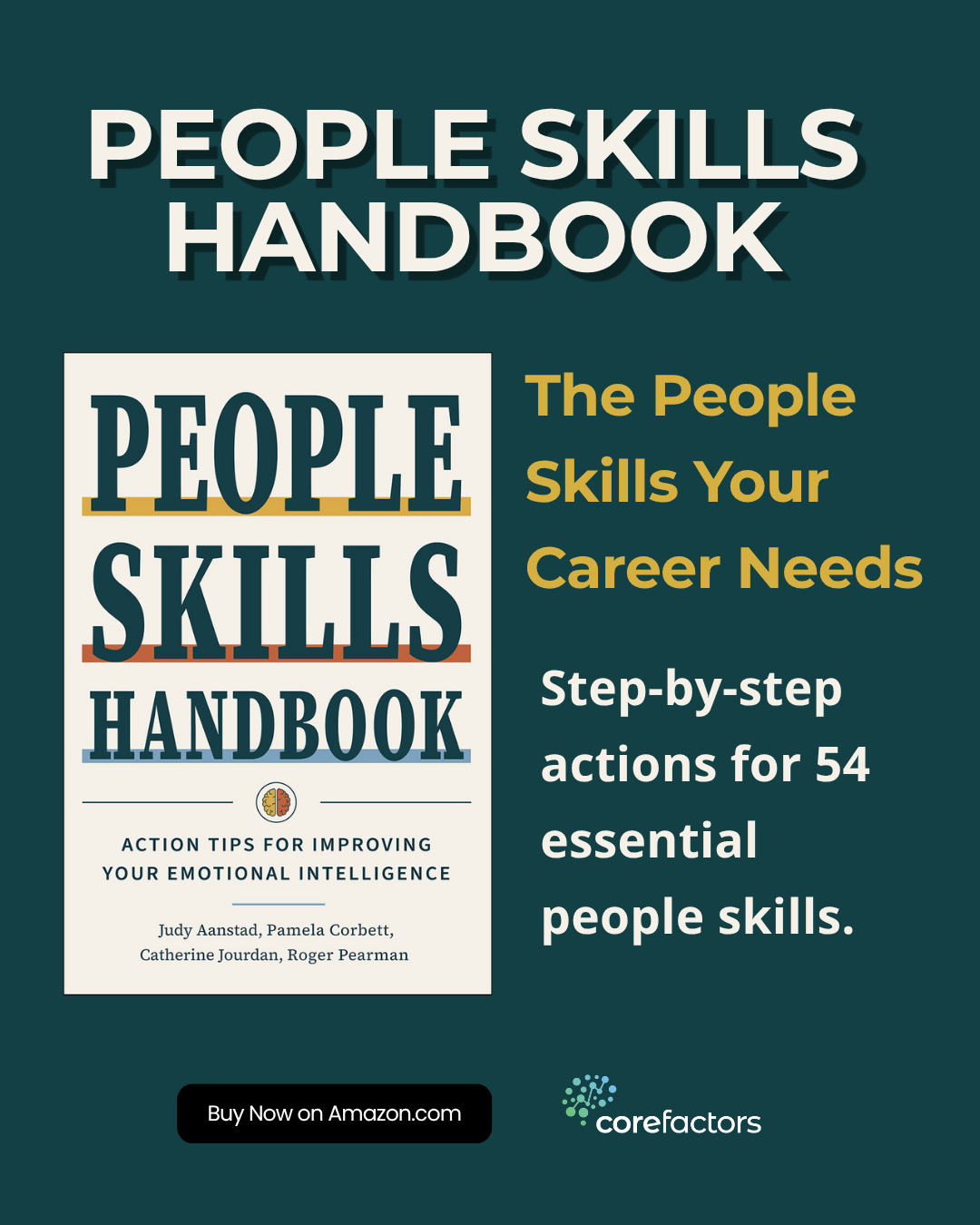
The People Skills Handbook returns in an updated edition from Core Factors. The handbook gives action tips for 54 emotional intelligence competencies.
Feedback tells a person which people skill to improve. The People Skills Handbook tells them how.”
TEMECULA, CA, UNITED STATES, October 19, 2026 /EINPresswire.com/ -- Core Factors, a people-development platform for coaches, consultants, and HR professionals, today published an updated edition of the People Skills Handbook: Action Tips for Improving Your Emotional Intelligence by Judy Aanstad, Ph.D., Pamela Corbett, M.A., Catherine A. Jourdan, MA.Ed., and Roger R. Pearman, Ed.D. The handbook was first published in 2012. Core Factors partnered with Pearman to redesign the book and update its references for the new edition. The handbook covers 54 emotional intelligence competencies. For each competency, the authors describe what the skill looks like at three levels of development, explain why the skill matters, identify barriers that keep a person from using the skill, and offer specific directions for building the skill. Coaches and HR professionals can use the book with clients and participants, and any reader can use the book on their own to develop a particular people skill. The updated edition is available in paperback from Amazon at $59.95 USD.— Kris Kiler
Most people who set out to improve a people skill already know which skill needs work. A 360 review, a performance conversation, or an assessment report may point to listening, patience, or conflict management. The harder question is what to do differently in the next meeting, the next disagreement, or the next difficult conversation.
In the preface, the four authors write that they “heard our clients ask again and again where they can learn more about how to develop compassion, or flexibility, or some other interpersonal trait or competency.” They add, “Very often our clients are open to learning but don’t know where to begin or how to determine their current skill level in an interpersonal skill that they hope to develop.” The literature on emotional intelligence has a great deal to say about why interpersonal skills matter. When the authors wrote the handbook, they had yet to find a book that described each emotional intelligence skill at the talented, skilled, and unskilled levels and gave concrete steps for developing each one. Core Factors has not found another book that does both today.
For practitioners, the lack of practical guidance shows up between coaching sessions. A client leaves with a development goal and, until the next meeting, little direction on how to work toward the goal.
“Feedback tells a person which people skill to improve. The People Skills Handbook tells them how,” said Kris Kiler, Founder and President of Core Factors. “When a 360 review says your listening needs work, the next question is what to do differently in tomorrow’s meeting. The handbook answers with specific actions for each of the 54 competencies. The four authors worked as executive coaches, psychologists, training facilitators, and counselors, and the action tips draw on research and on their work with clients. We brought the handbook back into print so a coach can recommend one book that covers every skill a client might work on, and so any reader can turn straight to the competency they want to improve.”
The People Skills Handbook is written for people who have decided to improve how they work with others. A reader can work on managing conflict, influencing others, and collaborating more effectively to advance a career. A reader can build stronger relationships at home and at work by increasing self-confidence, balancing independence with interdependence, and understanding themselves and others more clearly. A reader can also use patience, listening, and compassion to get work done through and with other people. Conflict Management, Influencing Others, Collaboration, Self-Confidence, Patience, Listening Generously, and Compassion all appear among the 54 emotional intelligence competencies in the handbook. Every competency contributes to success in relationships, personal well-being, and effectiveness at work.
Each of the 54 competencies follows the same structure. A concise definition focuses the reader on the target behavior. Behavioral descriptions at the Talented, Skilled, and Unskilled levels help readers judge their current skill level, while a Big Picture View explains why the competency matters. Barriers to Effectiveness name what keeps a person from using the skill. The Action Tips give practical steps a reader can start right away. Each competency also lists the work and non-work experiences that offer the most powerful learning opportunities. Resources for continued learning, including books, classes, and websites, complete each entry. The handbook also includes strategies for effective learning and goal setting, and a final toolbox gives each reader an EQ action plan to complete.
Coaches, HR professionals, and participants who work with emotional intelligence assessments can use the People Skills Handbook as a desk reference. One of the handbook’s eight toolboxes maps the scales of widely used emotional intelligence and personality assessments, including the EQ-i 2.0 and the MSCEIT, to the 54 competencies. Practitioners can start from a client’s score on any mapped scale and turn to the competencies linked to the scale. The handbook also works with the EQ Accelerator, the emotional intelligence assessment from Core Factors. The EQ Accelerator rates 40 emotional intelligence skills on importance and effectiveness and highlights one priority skill in each of four dimensions: Self-Awareness, Other Awareness, Self-Regulation, and Other Engagement. Participants can open the handbook to each highlighted skill and continue developing the skill between coaching sessions.
For an individual practitioner, the handbook gives clients a way to keep working between coaching sessions. A client can work on one competency between meetings, return with notes on what they tried, and use the next session to refine the practice. The same book works as pre-work before a 360 debrief or as a reference after a workshop.
For programs, the handbook gives a cohort a shared vocabulary for development. When every participant in a leadership program describes listening or conflict management in the same terms and at the same three levels, facilitators, managers, and coaches can discuss each participant’s progress in the same language. HR and talent teams can use the toolbox on career stallers to connect performance concerns to specific competencies and specific actions.
Over time, the handbook serves as a reference people keep and return to. The skills a person needs change with each new role and each new team, and the reader turns to the competency each new situation requires.
The People Skills Handbook (Core Factors, 491 pages, paperback, $59.95 USD) is available from Amazon. International Amazon marketplaces sell the book in local currency.
Coaches, consultants, and HR professionals who design leadership programs or coach individual development can use the handbook alongside any emotional intelligence assessment they already administer. The book also carries a reader offer for 25 percent off the EQ Accelerator. Practitioners can create a free Pro Account or request a demo to see the EQ Accelerator report and the Participant Hub.
About the Authors
Judy Aanstad, Ph.D., is a consultant, coach, and trainer who works with individuals and organizations in leadership, effective communication, career management, and team development. She has served as an adjunct executive coach and faculty member at the Center for Creative Leadership for more than 20 years and is a Board Certified Coach.
Pamela Corbett, M.A., is a psychologist and the owner of Spectrum Psychological Services in Winston-Salem, North Carolina. As adjunct faculty at the Center for Creative Leadership, she has focused on leadership and executive effectiveness for more than 20 years.
Catherine A. Jourdan, MA.Ed., is a Licensed Professional Counselor and Board Certified Coach. Her career spans more than three decades. Since 1977, she has provided coaching, feedback, and facilitation as adjunct staff in leadership development programs at the Center for Creative Leadership.
Roger R. Pearman, Ed.D., is a recognized authority on emotional intelligence and personality type and the developer of the EQ Accelerator®, People Skills 360™, and Brain Agility Lens™ assessments. He is the CEO of the talent development firm TalentTelligent, EOT. His research earned the Isabel Myers Memorial Research Award, and the Association for Psychological Type International awarded him the Mary McCaulley Lifetime Achievement Award.
About Core Factors
Core Factors is a people-development platform for practitioners. Executive coaches, OD consultants, L&D professionals, HR professionals, and career practitioners use Core Factors to administer assessments, deliver results, reinforce development between sessions, and document outcomes through participant feedback and reporting.
The assessment portfolio includes Type Discovery, Type Elements, and Type Dynamics for psychological type work across decision-making, learning, leadership, and interpersonal effectiveness. EQ Accelerator guides emotional intelligence development with a structured focus on priority skills and growth sequencing. Social Dynamics addresses interaction styles and their applications across communication, collaboration, influence, and conflict. Career Path and Career Signals support career alignment through occupational fit mapping and values-based career planning.
Every assessment is supported by the Participant Hub. In the Participant Hub, participants access results, explore model content, engage with structured reflection, and receive developmental guidance from Evidentra®. Evidentra is the Core Factors AI Coach Assistant. Core Factors is built on a commitment to psychometric integrity, ethical application, and practical results for both the practitioner and the people they develop.
Kris Kiler
Core Factors
+1 844-989-5323
Visit us on social media:
LinkedIn
Instagram
YouTube
Legal Disclaimer:
EIN Presswire provides this news content "as is" without warranty of any kind. We do not accept any responsibility or liability for the accuracy, content, images, videos, licenses, completeness, legality, or reliability of the information contained in this article. If you have any complaints or copyright issues related to this article, kindly contact the author above.
