

In-Space Manufacturing Market Surges at 29.78% CAGR Through 2035 as Additive Manufacturing Advances
In-Space Manufacturing Market
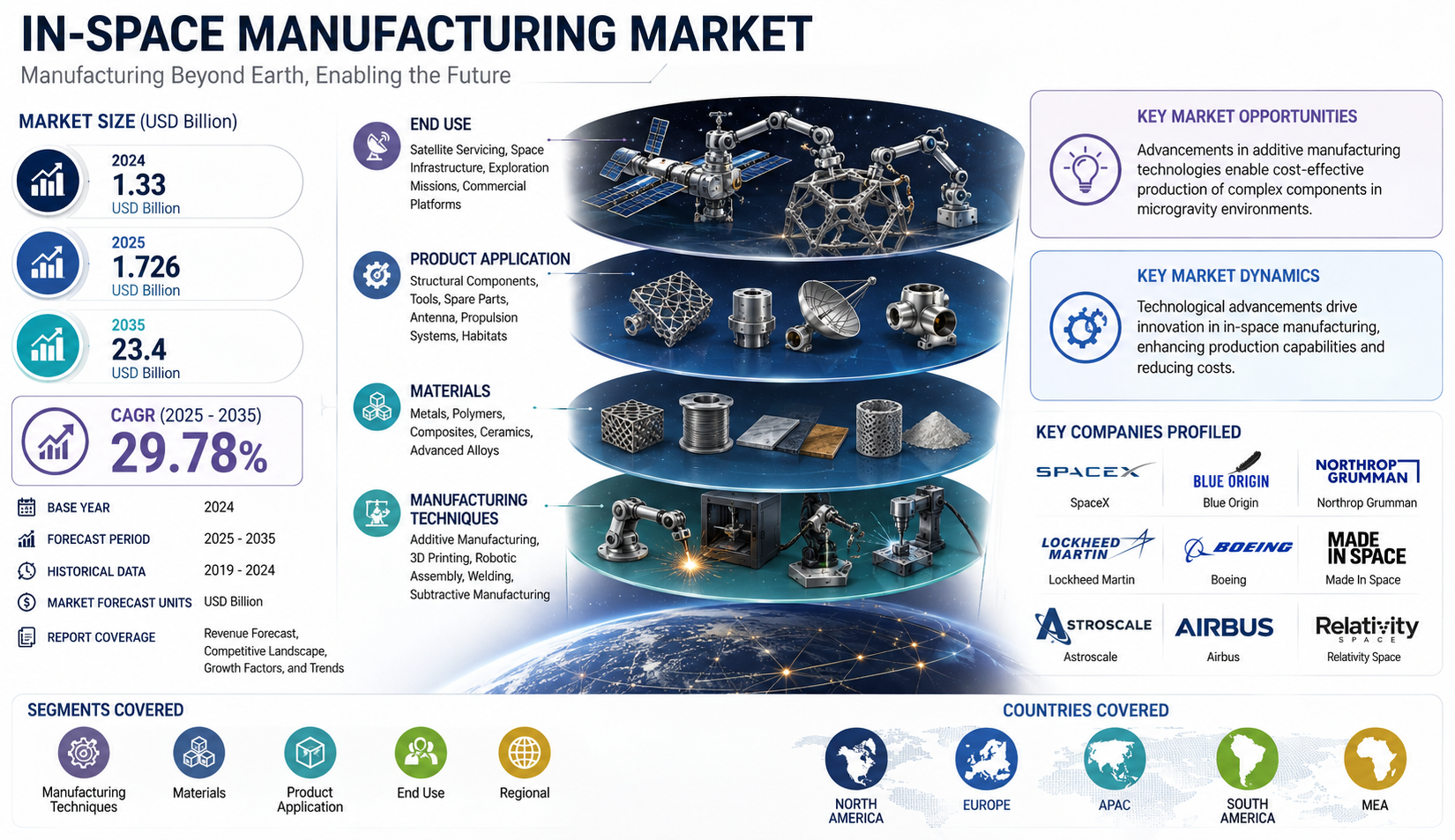
The in-space manufacturing market is projected to reach USD 23.4 billion by 2035, driven by microgravity production and advanced additive manufacturing.
NEW YORK, NY, UNITED STATES, August 31, 2026 /EINPresswire.com/ --The In-Space Manufacturing Market is entering a transformative phase as space agencies, aerospace companies, research institutions, and emerging commercial space ventures explore the ability to manufacture products beyond Earth. The market is valued at USD 1.33 billion in 2024 and is projected to reach USD 1.726 billion in 2025, before expanding to USD 23.4 billion by 2035, representing a 29.78% CAGR from 2025 to 2035. The market encompasses manufacturing activities performed in orbital and other space environments, including additive manufacturing, material processing, biomanufacturing, component production, and fabrication of structures.
The competitive landscape includes established aerospace and space-infrastructure companies such as SpaceX, Blue Origin, Northrop Grumman, Lockheed Martin, Boeing, Made In Space, Astroscale, Airbus, and Relativity Space. Competition is increasingly shaped by technological capability, launch and orbital infrastructure, manufacturing know-how, materials expertise, automation, and the ability to integrate production systems with spacecraft and commercial space stations. Made In Space, now associated with Redwire's space manufacturing activities, was an early participant in demonstrating additive manufacturing aboard the International Space Station (ISS). NASA reports that the first 3D printer was deployed on the ISS in 2014, establishing an important foundation for on-demand manufacturing in orbit.
The market's development is closely connected with the evolution of commercial space infrastructure. As orbital platforms become more capable and the space industry moves toward longer-duration missions, manufacturing locally can potentially reduce dependence on Earth-based supply chains. Instead of launching every replacement component, tool, structural element, or experimental material from Earth, future missions could produce selected items when required. NASA's in-space production initiatives specifically focus on demonstrating advanced materials and products in low Earth orbit that could eventually support terrestrial markets and future space missions.
Free Sample Copy - Access A Complimentary Copy of Our Report to Explore Its Content and Insights
https://www.marketresearchfuture.com/sample_request/26910
Market Dynamics and Key Growth Drivers
Technological advancement is the primary factor supporting market expansion. Improvements in additive manufacturing, robotics, digital design, process monitoring, materials science, and automation are making it increasingly practical to manufacture complex structures under microgravity conditions. Traditional terrestrial manufacturing can be constrained by gravity-driven sedimentation, convection, and other physical effects. Microgravity can alter these processes and, in selected applications, enable material structures that are difficult or expensive to produce on Earth.
The economics of space manufacturing also provide an important growth rationale. Launching spare parts and specialized equipment adds mass, volume, transportation requirements, and mission-planning complexity. On-demand manufacturing could allow spacecraft operators to carry raw feedstock instead of a large inventory of finished components. NASA's earlier demonstrations showed that additive manufacturing could produce tools and parts in orbit, supporting the broader objective of reducing dependence on resupply missions.
Long-duration exploration is another significant driver. Missions to the Moon, Mars, and other deep-space destinations will require greater levels of autonomy because conventional resupply becomes progressively more difficult. Manufacturing technologies could support maintenance, repairs, habitat construction, tooling, and replacement components. NASA's advanced manufacturing programs are already investigating additive manufacturing for spaceflight hardware, composite systems, on-orbit assembly, and construction using in-situ resources.
Segmentation Analysis
By Manufacturing Techniques
The manufacturing techniques segment includes additive manufacturing, advanced material processing, bioprinting, electronics manufacturing, and other emerging fabrication approaches. Additive manufacturing currently represents a foundational technology because it can convert digital designs into physical components while minimizing the need for extensive tooling.
Extrusion-based 3D printing has already been demonstrated in orbit, while research is expanding toward metal printing, composite manufacturing, electronic-device fabrication, and more sophisticated automated production. NASA-supported research has also examined electrohydrodynamic inkjet printing and other techniques for manufacturing electronics in microgravity.
Bioprinting represents another specialized area. Microgravity may provide conditions that allow cells and biological structures to organize differently from conventional terrestrial environments. Research has therefore expanded into tissue engineering, pharmaceutical production, and biological materials. Redwire's BioFabrication Facility, for example, demonstrated the on-orbit printing of a human knee meniscus, illustrating the potential of biomanufacturing as a future application area.
By Materials
The materials segment includes polymers, metals, ceramics, composites, biological materials, electronic materials, and other advanced feedstocks. Polymers have played an important role in early in-space additive manufacturing because of their comparatively manageable processing requirements. However, the industry's longer-term direction is toward materials capable of producing stronger, more durable, and more functional components.
Metals and advanced composites are particularly important for structural components, propulsion-related applications, spacecraft systems, and high-performance hardware. Research is also examining specialty glass, optical fibers, semiconductors, crystals, and biological materials. NASA identifies uniform crystals, semiconductors, specialty glass, optical fibers, and biological products among the areas that could benefit from microgravity manufacturing.
By Product Application
The product application segment covers spacecraft components, tools and spare parts, electronics, advanced materials, pharmaceuticals, biological products, research products, and structural components.
Tools and replacement parts represent a relatively direct application because they can address immediate operational requirements. Electronics and semiconductor production offer a more technically demanding opportunity, where microgravity may support manufacturing processes with specific material or structural advantages. Pharmaceutical and biological applications are also attracting interest because controlled microgravity environments can influence crystallization, tissue formation, and other biological processes.
By End Use
By end use, the market can be divided into commercial space companies, government and defense organizations, research institutions, pharmaceutical and biotechnology companies, and other industrial users.
Government space agencies remain important because they provide funding, testing infrastructure, research programs, and early technology demonstrations. Commercial companies, meanwhile, are increasingly focused on developing manufacturing services that can eventually generate revenue from customers outside traditional government space programs.
The pharmaceutical, biotechnology, semiconductor, and advanced-material industries could become increasingly important end users if orbital manufacturing demonstrates repeatable quality and commercially viable economics. NASA has already supported projects involving drug-delivery devices, stem-cell research, specialty glass, bioprinting, and semiconductor-related materials.
By Region
North America currently represents a major center for technology development because of its established aerospace ecosystem, government research programs, launch infrastructure, and concentration of commercial space companies. The United States has played a particularly important role in developing and demonstrating additive manufacturing and other production technologies in low Earth orbit.
Europe is developing capabilities through organizations and companies involved in advanced manufacturing, space infrastructure, biotechnology, and microgravity research. European participation in bioprinting and orbital manufacturing is also expanding, including projects supported through the European Space Agency.
Asia-Pacific (APAC) has growing potential because of increasing investment in space exploration, satellite technology, research infrastructure, and advanced manufacturing. Japan and other regional economies are developing capabilities that could support future orbital manufacturing activities.
South America and the Middle East & Africa (MEA) remain comparatively developing markets, but increasing interest in commercial space technologies, satellite applications, research partnerships, and aerospace infrastructure could create future opportunities.
Industry Developments
1. NASA advances on-demand electronics manufacturing research:
NASA-supported researchers have continued developing technologies for manufacturing electronics in microgravity. Recent work has examined advanced tool platforms and electrohydrodynamic inkjet printing for producing electronic devices, moving the concept beyond simple plastic components toward functional hardware.
2. Microgravity electronics research moves toward nanomanufacturing:
A 2026 study published in npj Advanced Manufacturing examined on-demand additive nanomanufacturing of electronics in microgravity, highlighting potential benefits such as reducing spare-part inventories, supporting repairs, and producing customized electronics during long-duration missions.
Competitive Landscape
The competitive environment is characterized by a combination of established aerospace corporations, commercial launch providers, space-infrastructure companies, and specialized manufacturing organizations. SpaceX and Blue Origin contribute through launch and space-infrastructure capabilities, while Northrop Grumman, Lockheed Martin, Boeing, and Airbus bring extensive aerospace engineering, spacecraft manufacturing, and systems-integration expertise.
Made In Space has historical importance in orbital additive manufacturing, while Astroscale is positioned within the broader on-orbit services ecosystem. Relativity Space brings additive manufacturing expertise into launch-vehicle production. The competitive landscape is therefore not limited to companies that manufacture products directly in orbit; it also includes organizations developing launch systems, spacecraft, robotic platforms, digital manufacturing systems, materials, and orbital infrastructure.
As the market develops, competitive differentiation is expected to depend increasingly on manufacturing reliability, material performance, automation, certification, orbital logistics, production economics, and the ability to translate experimental demonstrations into repeatable commercial services.
Future Outlook
The In-Space Manufacturing Market is expected to evolve from experimental demonstrations toward increasingly specialized commercial production. The projected growth from USD 1.726 billion in 2025 to USD 23.4 billion by 2035 reflects expectations for rapid expansion across additive manufacturing, advanced materials, bioprinting, electronics, and spacecraft-related applications.
A major transition will be the movement from manufacturing simple tools and demonstration parts toward producing high-value products that have a clear economic or operational advantage over Earth-based manufacturing. NASA's continuing In Space Production Applications program illustrates this broader transition by targeting technologies capable of producing advanced materials and products for both space and terrestrial markets.
Over the longer term, manufacturing could become an integral component of space infrastructure rather than an isolated research activity. Commercial space stations, lunar infrastructure, deep-space missions, autonomous robotic systems, and increasingly sophisticated spacecraft could create demand for localized production. However, challenges including launch costs, feedstock availability, quality assurance, radiation exposure, thermal management, process control, automation, regulatory requirements, and limited orbital infrastructure will continue to influence market adoption.
Overall, the market's 29.78% CAGR between 2025 and 2035 reflects the convergence of additive manufacturing, microgravity science, robotics, space commercialization, and advanced materials. The industry's progress will ultimately depend on whether these technologies can demonstrate consistent production quality and compelling economics while moving from laboratory-scale experiments to scalable manufacturing operations.
FAQs
1. What is in-space manufacturing?
In-space manufacturing refers to producing, assembling, or processing components, materials, biological products, and other goods in orbital or space environments rather than manufacturing them entirely on Earth.
2. What is driving the growth of the In-Space Manufacturing Market?
Key drivers include advancements in additive manufacturing, reduced dependence on Earth-based resupply, growing commercial space infrastructure, long-duration exploration missions, and the potential to manufacture specialized materials and products under microgravity conditions.
Read Our Related Research Report
Space Habitat Market -
https://www.marketresearchfuture.com/reports/space-habitat-market-23922
Space Situational Awareness (SSA) Market -
https://www.marketresearchfuture.com/reports/space-situational-awareness-market-9534
Space Lander and Rover Market -
https://www.marketresearchfuture.com/reports/space-lander-rover-market-12307
Space Robotics Market -
https://www.marketresearchfuture.com/reports/space-robotics-market-8555
Space Militarization Market -
https://www.marketresearchfuture.com/reports/space-militarization-market-33084
Sagar Kadam
Market Research Future
+1 628-258-0071
email us here
Legal Disclaimer:
EIN Presswire provides this news content "as is" without warranty of any kind. We do not accept any responsibility or liability for the accuracy, content, images, videos, licenses, completeness, legality, or reliability of the information contained in this article. If you have any complaints or copyright issues related to this article, kindly contact the author above.
