

Programmable directional photonic spiking neuron based on a non-Hermitian silicon microresonator
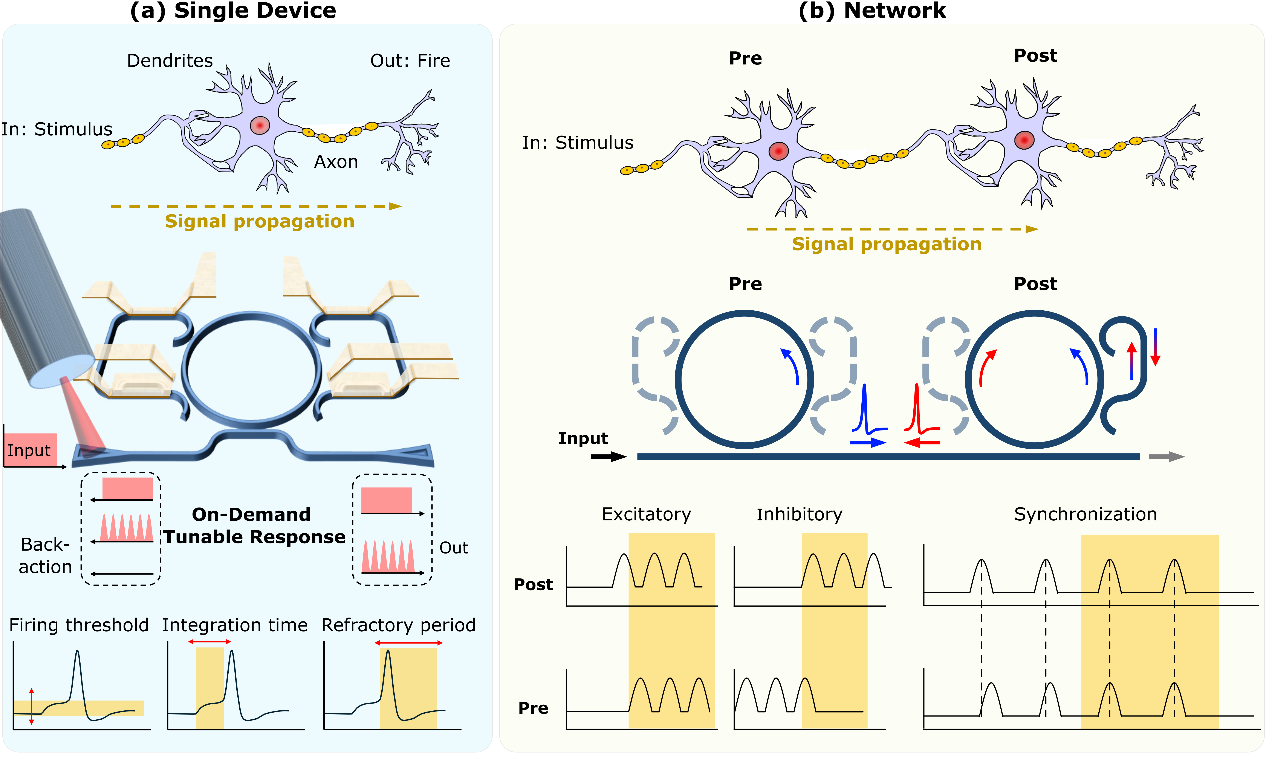
A programmable photonic neuron and its network behavior.
SHANNON, CLARE, IRELAND, August 28, 2026 /EINPresswire.com/ -- Announcing a new publication from Opto-Electronic Sciences; DOI 10.29026/oes.2026.260038.
Modern computers keep processing and memory in separate locations, so transferring data between them costs time and energy. This limitation is becoming increasingly apparent as artificial intelligence grows. The brain works differently: memory and computation are closely intertwined, and information is carried by the timing of short pulses, or spikes. The aim of neuromorphic engineering is to borrow this design, and light is an appealing medium for doing so, because it offers high speed, natural parallelism, and low energy consumption.
Photonic microresonators are promising building blocks for this purpose because they can reproduce several key features of biological neurons using light alone. When properly designed, these tiny optical devices can respond selectively to inputs, emit brief pulses, and become temporarily less responsive, or entirely unresponsive, after firing. These behaviors arise naturally from the interplay between light and the material properties of the resonator, without requiring external circuitry.
However, conventional microresonators have an important limitation: they respond in essentially the same way when light travels through them in one direction or the other. Biological neurons, in contrast, have a strong directional character. Signals typically travel from the input side of a neuron to its output, whereas propagation in the reverse direction is restricted. This asymmetry is important because it influences how neurons interact and helps to prevent unwanted feedback from spreading through a network.
In practice, this has direct consequences for photonic neural networks. A microresonator that emits a spike in response to an input can also send an uncontrolled signal back toward the previous node, because the forward and backward responses are intrinsically linked. Programmable directionality could break this link: a photonic neuron could fire when driven from one direction while remaining inactive when driven from the other, and its backward signal could be independently suppressed or deliberately enhanced. Such control could reduce unwanted crosstalk while turning backward signals into a resource for controlling interactions between neighboring neurons.
The authors of this article have provided a solution in the form of a device called DRUM, Dynamically Reconfigurable Unified Microresonator. This device comprises a silicon ring-shaped waveguide connected to two side lobes, each of which incorporates two microheaters (see Figure 1(a)). The flow of small currents through these heaters controls how light is exchanged between the two directions in which it can circulate inside the ring. In an ordinary microresonator, by contrast, this property is fixed once the chip is fabricated. That control is enough to change how the device behaves. Driven from one direction, the ring accumulates enough energy to break a steady laser beam into a train of optical spikes. Driven from the other, it remains quiet even when the incoming power is pushed well beyond the typical firing threshold. The same physical component can be operated in three distinct regimes: silent, excitable, or hypersensitive, without altering its geometry, allowing a single element to perform roles that would otherwise require different devices.
The authors explored what this control makes possible, revealing consequences that are unusually rich for such a simple structure. Tuning the heaters shifts the power at which the device starts firing, changes the interval over which incoming light is accumulated before a spike is emitted, and substantially lengthens the recovery time that follows a spike, all within the same component. A numerical model based on the interplay between thermal and free-carrier effects in silicon reproduces these behaviors and clarifies their origin.
Just as importantly, the spike is emitted predominantly in one direction, while a weaker signal is reflected back toward the input. This return signal, namely back-action, creates a channel through which one neuron can influence the one preceding it. Backward signaling of this kind mimics that of biological neurons, where backpropagating signals can travel from the axon toward the soma and dendrites and contribute to neuronal regulation and plasticity. In the DRUM, this back-action can be electrically controlled.
Simulations of two DRUMs coupled along a shared waveguide show that the reflected signal emitted by one node can trigger firing in the other, suppress the other's oscillation, or lock the two into synchronized firing (Figure 1(b)). These outcomes provide optical analogues of excitatory, inhibitory, and synchronizing synaptic interactions without requiring any additional component between the neurons. Because the devices are fabricated in silicon using standard processes and exploit the material's intrinsic nonlinearities rather than external gain, they offer a potential route toward larger photonic circuits. Programmable directionality could help stabilize such networks by controlling the crosstalk that unregulated optical feedback would otherwise spread from node to node. Taken together, these results identify a single reconfigurable component that combines functions typically assigned to several different devices, bringing photonic spiking networks closer to scalable, event-driven neuromorphic computing.
Keywords: neuromorphic photonics; microring resonator; non-Hermitian system; integrated photonics
# # # # # #
The Nanoscience Laboratory of the Department of Physics at the University of Trento, led by Prof. Lorenzo Pavesi, brings together about twenty people, including professors, researchers, postdoctoral fellows, and PhD students, around a common question: what can be achieved with light when it is confined in an integrated photonic circuit? Its activities share a common approach, mainly based on silicon and silicon nitride platforms fabricated using standard microelectronics processes, and span four main directions.
In quantum photonics, photonic circuits, from microresonators to waveguide spirals, are used to generate non-classical states of light, including single photons, for quantum computing and simulation. In non-Hermitian photonics, the group studies structures in which loss and asymmetric coupling are exploited rather than avoided, providing access to exceptional points, nonlinear phenomena, and the breaking of reciprocity on which the present work is built. In neuromorphic photonics, arrays of microresonators become artificial neural networks, supporting reservoir computing and extreme learning machines for benchmark and real-world tasks, as well as more recently developed approaches based on spiking neural networks. Finally, at the interface with biology, the laboratory develops hybrid chips in which living neurons are coupled to photonic circuits through light-sensitive proteins, both to explore new forms of artificial intelligence and to investigate how the brain develops and forms memories.
Together, these research directions make integrated photonics a common ground where quantum optics, neuroscience, and information processing meet.
# # # # # #
Opto-Electronic Science (OES) is a peer-reviewed, open access, interdisciplinary and international journal. OES has been indexed in ESCI, Scopus, DOAJ, and CAS databases, with a Scopus CiteScore Tracker of 30.7 for 2025 and a JCR Immediate Impact Factor of 26.
# # # # # #
More information: https://www.oejournal.org/oes
Editorial Board: https://www.oejournal.org/oes/editorialboard/list
All issues available in the online archive (https://www.oejournal.org/oes/archive)
Submission of OES may be made using ScholarOne (https://mc03.manuscriptcentral.com/oes)
CN 51-1800/O4
ISSN 2097-0382
Contact Us: oes@ioe.ac.cn
Twitter: @OptoElectronAdv (https://twitter.com/OptoElectronAdv?lang=en)
WeChat: OE_Journal
# # # # # #
Biasi S, Aslan B, Gretter S et al. Programmable directional photonic spiking neuron based on a non-Hermitian silicon microresonator. Opto-Electron Sci 5, 260038 (2026). DOI: 10.29026/oes.2026.260038
Opto-Electronic Science Editorial Office
Opto-Electronic Science
+86 591 2286 1222
email us here
Legal Disclaimer:
EIN Presswire provides this news content "as is" without warranty of any kind. We do not accept any responsibility or liability for the accuracy, content, images, videos, licenses, completeness, legality, or reliability of the information contained in this article. If you have any complaints or copyright issues related to this article, kindly contact the author above.
