

Arteriovenous Malformation Market to reach USD 6.07 Billion by 2035 at 5.96% CAGR
Arteriovenous Malformation Market,
Arteriovenous Malformation Market to Surge from USD 3.40 Bn in 2025 to USD 6.07 Bn by 2035—By Rising AVM Prevalence, Minimally Invasive Treatment Advances
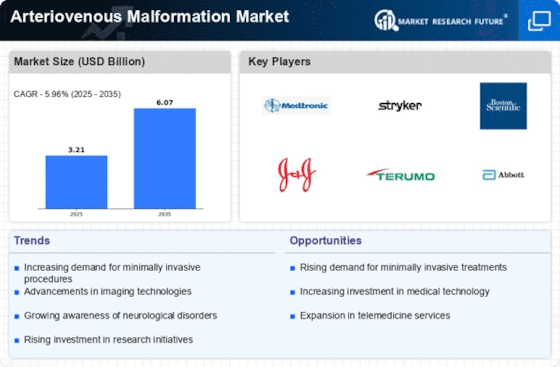
NY, CA, UNITED STATES, August 28, 2026 /EINPresswire.com/ -- As per Market Research Future, the global Arteriovenous Malformation Market size is projected to reach USD 6.07 Billion by 2035 from USD 3.40 Billion in 2025, at a CAGR of 5.96% during the forecast period 2025–2035. The market base was estimated at USD 3.21 Billion in 2024.The 5.96% CAGR—anchored by structural shifts in neurovascular care—is propelled by three converging forces: the rising global prevalence of arteriovenous malformations, with AVMs affecting approximately 1 in 100,000 individuals and driving healthcare providers to increasingly adopt advanced embolization and neurosurgical interventions for superior hemorrhagic stroke prevention and long-term patient outcomes; advancements in minimally invasive treatment technologies, particularly endovascular embolization devices, liquid embolics, flow diverters, and AI-integrated diagnostic imaging, which significantly improve procedural safety, reduce recovery times, and enhance patient compliance; and the integration of personalized medicine approaches, including genetic and phenotypic profiling, that enable tailored treatment plans and minimize adverse effects for complex vascular anomalies.
Global medical device manufacturers and health organizations are amplifying this momentum. Medtronic launched a new neurovascular device specifically designed for AVM treatment in August 2025, reflecting strong investment in minimally invasive neurovascular innovation. Stryker completed the acquisition of a leading neurovascular technology firm in September 2025, bolstering its capabilities in AVM intervention. Boston Scientific entered a partnership with a prominent healthcare institution in July 2025 to develop personalized medicine protocols for AVM management. According to WHO and NINDS data, AVMs affect roughly 1 in 100,000 individuals worldwide, with brain scans representing the most trusted diagnostic modality. These forces are creating the clinical infrastructure and patient demand on which the Arteriovenous Malformation Market depends.
Request A Free Sample:
https://www.marketresearchfuture.com/sample_request/5092
Key Market Trends & Growth Drivers
Rising Incidence of Arteriovenous Malformations
The market is witnessing increasing demand driven by the rising incidence of AVMs. As diagnostic techniques improve, allowing for earlier detection, more individuals are seeking effective neurovascular interventions. Studies indicate that AVMs affect approximately 1 in 100,000 individuals, leading to a growing patient population requiring treatment. This trend indicates a shift in clinical attitudes toward proactive vascular anomaly management, with AVM treatments being recognized for their critical role in preventing hemorrhagic strokes. Medtronic continues advancing product development through next-generation neurovascular devices while strengthening strategic partnerships supporting AVM research.
Advancements in Minimally Invasive Treatment Technologies
Innovations in treatment modalities are becoming a hallmark of the industry. The development of minimally invasive surgical techniques, such as endovascular embolization, has transformed treatment protocols for AVMs. These advancements aim to enhance patient outcomes, reduce recovery times, and improve procedural safety, potentially leading to better health outcomes and increased market penetration. Endovascular embolization commanded the largest treatment share, driven by its non-invasive nature and favorable patient outcomes. Boston Scientific continues strengthening neurovascular treatment portfolios through sustained product innovation.
Integration of AI-Driven Diagnostic and Personalized Medicine
The incorporation of artificial intelligence and personalized medicine into the industry is gaining traction. Advanced imaging technologies such as MRI and CT scans have improved the accuracy of AVM diagnosis, facilitating timely interventions. Tailoring treatment plans to individual patient profiles, including genetic and phenotypic characteristics, is becoming increasingly feasible, enhancing therapeutic effectiveness and minimizing adverse effects. Tools such as AI-driven diagnostic algorithms are being utilized to monitor vascular anomalies and facilitate communication between interventional neuroradiologists and neurosurgeons, enhancing treatment outcomes.
Increased Funding for Research and Development
The rising investment in neurovascular R&D is a primary driver. Government and private sector investments are increasingly directed towards understanding the pathophysiology of AVMs and developing novel therapeutic approaches. This financial support is essential for fostering innovation, leading to the discovery of new treatment modalities and enhancing existing ones. The market is projected to expand as healthcare providers increasingly adopt advanced AVM treatments to manage complex vascular conditions. The World Health Organization and National Institute of Neurological Disorders and Stroke have identified vascular anomalies as a global health priority, underscoring the urgent need for innovative solutions.
Ask for Customization:
https://www.marketresearchfuture.com/ask_for_customize/5092
Market Segment Insights
BY TYPE
True Arteriovenous Malformation: Largest segment, valued at USD 0.96 Billion in 2024, driven by higher prevalence and the established range of treatment options available. Medtronic continues expanding neurovascular device portfolios through sustained product innovation.
Dural Fistula: Fastest-growing segment, appealing to patients seeking specialized vascular anomaly interventions with unique therapeutic needs.
Cavernous Malformations: Positioned as a significant sub-segment, projected to reach USD 1.25 Billion by 2035, catering to occult or cryptic AVM caseloads.
BY DIAGNOSIS
Brain Scans: Largest segment with USD 1.44 Billion in 2024, benefiting from non-invasive nature and reliability in providing critical imaging insights into vascular anomalies. The segment is projected to reach USD 2.76 Billion by 2035.
Blood Tests: Fastest-growing diagnostic segment, driven by increasing awareness of early diagnosis and improved test methods that offer quicker results.
Physical Examination: Significant share, serving as the initial screening pathway for patients presenting with neurological symptoms.
BY TREATMENT
Endovascular Embolization: Dominant treatment with a substantial market share, offering robust efficacy and established preference among interventional neuroradiologists due to its minimally invasive nature. The segment is projected to reach USD 2.8 Billion by 2035.
Neurosurgery: Fastest-growing treatment segment, appreciated for its effectiveness in critically located AVMs and driven by ongoing R&D efforts that enhance safety and efficacy.
Others: Smaller but significant share, reflecting emerging adjunctive and combination therapeutic approaches.
BY END USER
Hospitals & Clinics: Largest segment, benefiting from comprehensive facilities, advanced technology, and established infrastructure that facilitate effective diagnosis and treatment. The segment is projected to be worth USD 2.8 Billion by 2035.
Research Laboratories: Fastest-growing end-user channel, gaining traction among stakeholders seeking protocol development, clinical trials, and innovative treatment modalities.
Others: Smaller share, encompassing specialized neurological institutes and ambulatory surgical centres.
Read Detailed Insights:
https://www.marketresearchfuture.com/reports/arteriovenous-malformation-market-5092
Regional Outlook
North America — Market Leader in Innovation
North America leads with 45% of global revenue in 2025, generating around USD 1.4 Billion. The region's growth is driven by advanced healthcare infrastructure, increasing prevalence of AVMs, significant investments in research and development, and favorable regulatory support from agencies like the FDA. According to NINDS, AVMs affect approximately 1 in 100,000 individuals, while the CDC underscores the importance of early neurovascular intervention. The competitive landscape is characterized by continuous innovation and strategic partnerships among leading medical device companies.
Europe — Second Largest Market
Europe represents the second-largest regional market with a 30% share. The region benefits from robust healthcare systems, increasing awareness of AVM conditions, and supportive regulatory frameworks. Regulatory bodies like the EMA are actively facilitating the approval of new therapies. Leading countries include Germany, France, and the UK, where major companies such as B. Braun Melsungen AG and Terumo Corporation are heavily invested.
Asia-Pacific — Rapidly Growing Market Segment
The Asia-Pacific region accounts for approximately 20% of the global share. The growth is driven by increasing healthcare expenditure, rising awareness of AVM conditions, and advancements in medical technology. Countries like Japan and China are at the forefront, with government initiatives aimed at improving healthcare access and treatment options. Japan holds a major market share for being one of the most prominent places as the regional market due to the increasing availability of technology and huge healthcare spending. The competitive landscape is evolving with companies like Abbott Laboratories and Terumo Corporation leading the charge.
Middle East and Africa — Untapped Potential
The MEA region holds around 5% of the global share, reaching approximately USD 0.2 Billion in 2025, driven by increasing awareness of AVM conditions, medical tourism, and rising healthcare investments. Countries like the UAE and Saudi Arabia are leading the way, with a growing presence of international medical device companies. South Africa is emerging as a regional referral hub for neurovascular care.
Competitive Landscape and Recent Developments
The Arteriovenous Malformation market is characterized by intense competition and rapid growth, driven by increasing prevalence of AVMs worldwide. The global industry appears moderately fragmented, with several key players exerting significant influence.
KEY COMPANIES AND RECENT MILESTONES
Medtronic (US) (August 2025): Announced the launch of a new neurovascular device designed specifically for the treatment of AVMs, which is expected to enhance procedural efficiency and patient safety. This strategic move underscores Medtronic's focus on innovation and its commitment to addressing unmet clinical needs in the neurovascular space.
Stryker (US) (September 2025): Completed the acquisition of a leading neurovascular technology firm, which is anticipated to bolster its capabilities in AVM treatment. This acquisition reflects Stryker's strategy to enhance its technological prowess and expand its market footprint in neurovascular interventions.
Boston Scientific (US) (July 2025): Entered into a partnership with a prominent healthcare institution to develop a new treatment protocol for AVMs, focusing on personalized medicine approaches. This collaboration highlights Boston Scientific's commitment to innovation and its strategic focus on improving patient outcomes through tailored therapies.
Other Key Players: Johnson & Johnson (US), Terumo Corporation (JP), Abbott Laboratories (US), B. Braun Melsungen AG (DE), Penumbra, Inc. (US).
Future Outlook: 2025–2035
The Arteriovenous Malformation Market is projected to reach USD 6.07 billion by 2035, growing at a CAGR of 5.96%, driven by increasing AVM prevalence, rising awareness, and advancements in minimally invasive treatment technologies.
New opportunities lie in:
Development of next-generation minimally invasive surgical techniques and liquid embolics
Expansion of telemedicine platforms for remote neurovascular consultations
Investment in AI-driven diagnostic tools for early AVM detection and treatment planning
Personalized medicine approaches leveraging genetic and phenotypic patient profiling
Cross-border neurovascular care corridors and medical tourism in Europe and Middle East
By 2035, the Arteriovenous Malformation Market is expected to achieve substantial growth and innovation, with market leadership belonging to players who succeed in delivering superior patient-centric neurovascular solutions.
More Related Research Insights:
https://www.marketresearchfuture.com/reports/microrna-market-21849
https://www.marketresearchfuture.com/reports/healthcare-it-market-5950
https://www.marketresearchfuture.com/reports/decentralized-clinical-trials-market-43170
https://www.marketresearchfuture.com/reports/catheters-market-3186
https://www.marketresearchfuture.com/reports/pulmonary-arterial-hypertension-market-22006
https://www.marketresearchfuture.com/reports/protein-engineering-market-691
https://www.marketresearchfuture.com/reports/biosimulation-market-8580
https://www.marketresearchfuture.com/reports/parenteral-nutrition-market-43392
https://www.marketresearchfuture.com/reports/organ-preservation-market-6073
https://www.marketresearchfuture.com/reports/clinical-trials-market-7787
Market Research Future
Market Research Future
+1 855-661-4441
email us here
Legal Disclaimer:
EIN Presswire provides this news content "as is" without warranty of any kind. We do not accept any responsibility or liability for the accuracy, content, images, videos, licenses, completeness, legality, or reliability of the information contained in this article. If you have any complaints or copyright issues related to this article, kindly contact the author above.
